

Between laboratory research and development and industrial mass production, technology transformation often faces difficulties such as reduced efficiency and surging costs. Ultra-high pressure homogenization technology ensures that sensitive substances such as nanomaterials and biological agents maintain structural stability during the scale-up production process by precisely controlling pressure parameters, thereby reducing performance loss. Among them, the precise pressure control system of industrial-grade equipment can adjust the homogenization intensity in real time to match the needs of different experimental stages; the modular design can quickly adapt to process changes from small trials to mass production through flexible combination of functional units. At the same time, the innovative application of pilot-scale amplification technology further shortens the R&D cycle and provides reliable guarantees for the industrialization of fields such as medicine and new energy.
Ultra-high pressure homogenization technology breaks through bottlenecks
In the past, when laboratory equipment was expanded, pressure fluctuations often caused deviations in material properties. The industrial-grade ultra-high pressure homogenizer controls the pressure fluctuation amplitude within ±0.5% through a multi-stage hydraulic compensation system, just like installing a "pressure stabilizer" for the production line. This precision control capability enables the laboratory-verified nanoparticle size parameters to be fully replicated in the pilot production line. For example, in the preparation of carbon quantum dots, the equipment successfully transferred the laboratory-optimized 5nm particle size standard to a 100-liter reactor, and the particle size deviation was always less than ±0.8nm. Its built-in intelligent feedback module can also adjust the pressure curve in real time to ensure the consistency of the processing effects of different batches, completely eliminating the problem of material performance attenuation caused by pressure drift in traditional equipment.
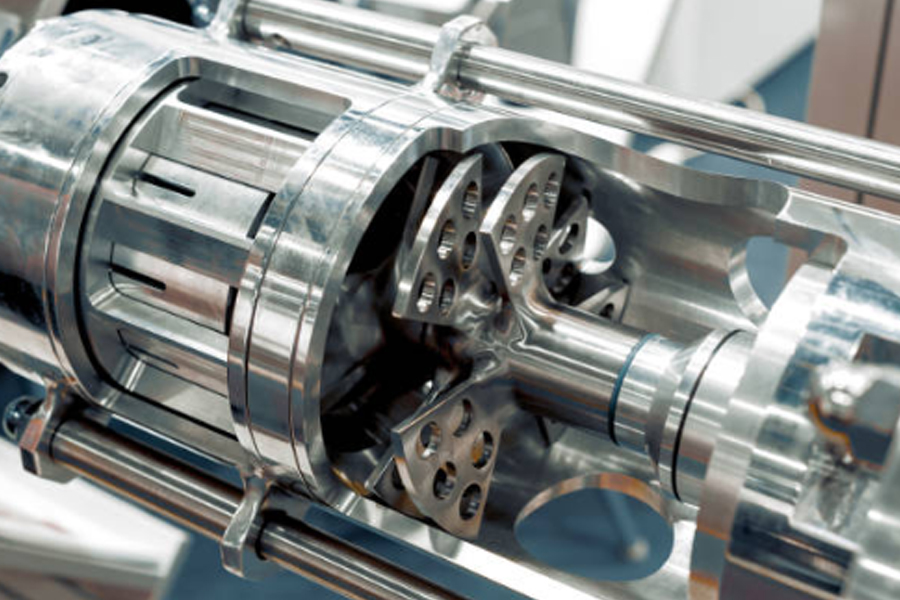
Precise pressure control to achieve zero-loss conversion
In the process of converting laboratory results into large-scale production, it is crucial to maintain high precision and stability of pressure. The industrial-grade ultra-high pressure homogenizer is equipped with an advanced intelligent pressure control system that can monitor and accurately adjust the pressure value during the processing process in real time. This precise control capability effectively eliminates the problems of uneven material processing, particle agglomeration or destruction of effective ingredients caused by pressure fluctuations in traditional methods. More importantly, it ensures that the results of each treatment are highly consistent with the laboratory test, truly realizing the "zero-loss" conversion from the research and development stage to the pilot scale-up stage. This precise pressure stability is the core technical support for ensuring the quality and production efficiency of products such as nanomaterials and biological agents that are extremely sensitive to processing conditions.
Modular design facilitates closed-loop mass production
The modular design of the industrial-grade ultra-high pressure homogenizer provides a flexible technical framework for large-scale production. By designing the core functional units (such as pressure generation modules and material processing chambers) as independent and replaceable standardized components, the equipment can be combined on demand like "building blocks". When the laboratory-verified nanomaterial preparation process needs to be scaled up, it is only necessary to add parallel homogenization units or replace larger capacity processing modules to achieve a linear increase in production capacity and avoid process parameter deviation due to equipment reconstruction. On this basis, the intelligent interconnection system between modules can synchronize key parameters such as pressure and flow in real time to ensure the consistency of production batches of different scales. In this way, enterprises can not only retain the process advantages of the laboratory stage, but also respond quickly to changes in market demand, significantly reducing the trial and error costs from pilot to mass production.
Analysis of the application of pilot scale-up technology
In the process of transforming laboratory results into large-scale production, pilot scale-up technology plays a key role. The industrial-grade ultra-high pressure homogenizer uses a precise pressure control system to ensure that the process parameters (such as pressure range and homogenization rate) in the experimental stage can be directly replicated in the mass production stage. For example, in the preparation of nanomaterials, the equipment can dynamically adjust pressure fluctuations (within ±0.5%) to avoid uneven particle size distribution or structural damage caused by pressure deviation. The modular design further simplifies the production process, and different functional units (such as pretreatment chambers and homogenization core areas) can be quickly combined or replaced, so that the production line can flexibly adapt to the production needs of diversified products such as biological preparations and pharmaceutical carriers. By integrating real-time data monitoring and automated feedback mechanisms, this technology shortens the verification cycle of the pilot stage by more than 40%, greatly reducing the cost of trial and error.
By deeply integrating precise pressure control with modular design, industrial-grade ultra-high pressure homogenizers provide reliable technical support for pilot scale-up. This equipment can not only stably reproduce the particle size distribution of nanomaterials under laboratory conditions, but also adapt to the needs of different production scales by flexibly adjusting pressure parameters, greatly reducing the process verification cycle. In the industrialization cases from biological preparations to new energy materials, the rapid replacement capability of modular components effectively avoids the overall downtime risk of traditional equipment due to local failures. The construction of this closed-loop technology has enabled the "last mile" between laboratory results and mass production to achieve zero loss, paving the way for large-scale production of high value-added products.